
Seed Bomb School Projects in Ireland
Seed bomb school projects give children, teachers and community groups a simple way to explore wildflowers, pollinators, biodiversity and responsible planting in gardens, pots, planters and prepared soil.
Quick answer: how do seed bomb school projects work?
Seed bomb school projects work by giving pupils a small planting activity they can manage and observe over time. The best approach is to use pots, planters, raised beds or bare-soil patches where seed bombs can make contact with soil and receive moisture and light.
A school seed bomb project should not be based on throwing seed bombs into long grass and hoping for results. It should be planned, supervised and located somewhere the class can water, monitor and learn from the project.
Seed bomb school project ideas
Seed bomb school projects are useful because they combine practical planting with observation, discussion and simple biodiversity learning.
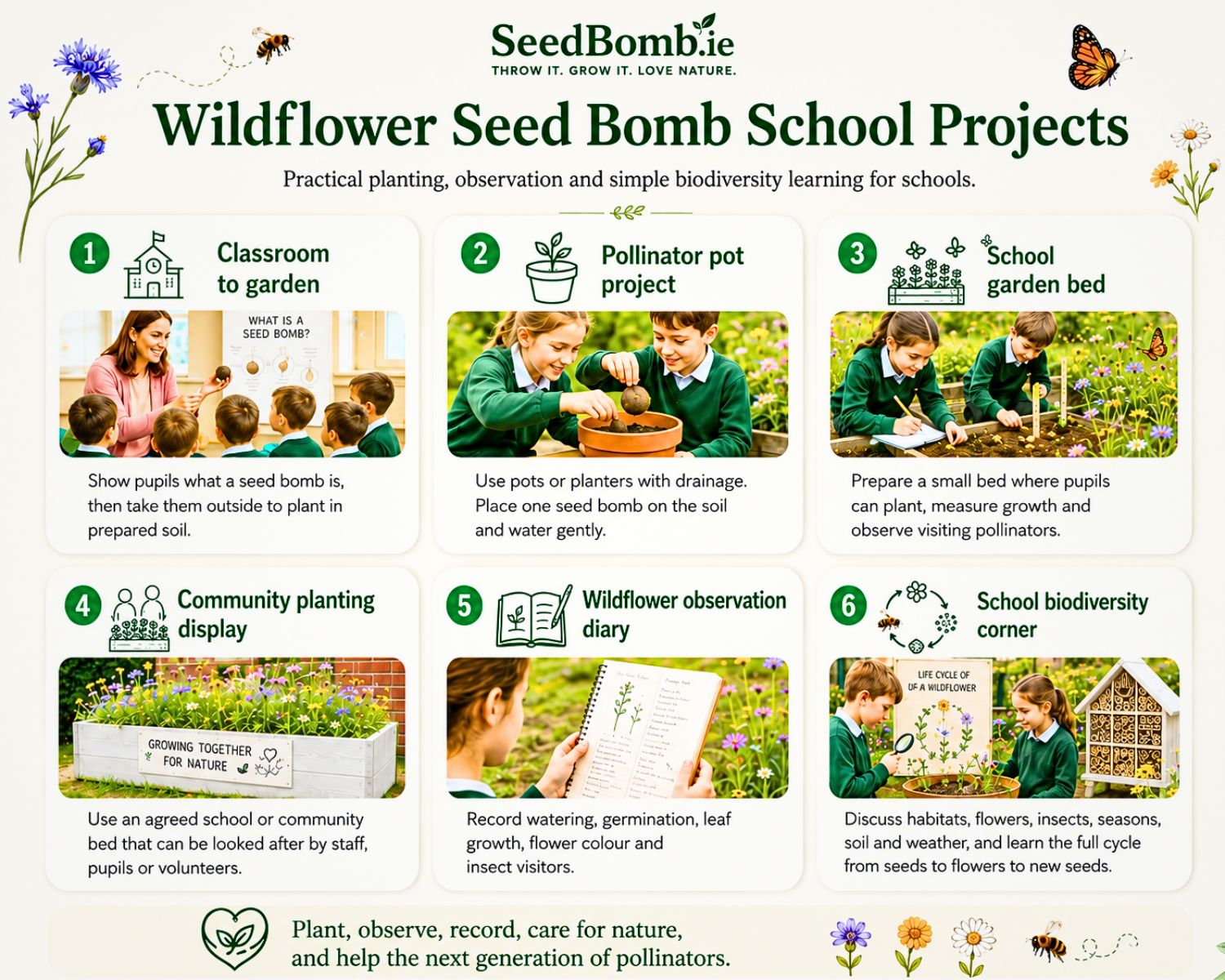
Classroom-to-garden planting
Introduce the seed bombs indoors, explain what is inside them, then bring pupils outside to place them into prepared soil.
Pollinator pot project
Use pots or planters with drainage, place one seed bomb per suitable container, and let pupils water and monitor progress.
School garden bed
Prepare a small bed where pupils can plant seed bombs, record weather, measure growth and observe flowering later in the season.
Community planting display
Use an agreed school or community bed where planting is permitted and the project can be maintained by staff, pupils or volunteers.
Wildflower observation diary
Pupils can record watering, germination, leaf growth, flower colour and any pollinating insects that visit.
School biodiversity corner
Set aside a small area to discuss habitats, flowers, insects, seasons, soil, weather and the importance of caring for living things.
How to run seed bomb school projects safely
A good school project should be easy to supervise, clear to explain and realistic to maintain. Prepared soil and simple routines make the project stronger.
Where school and community seed bomb projects work best
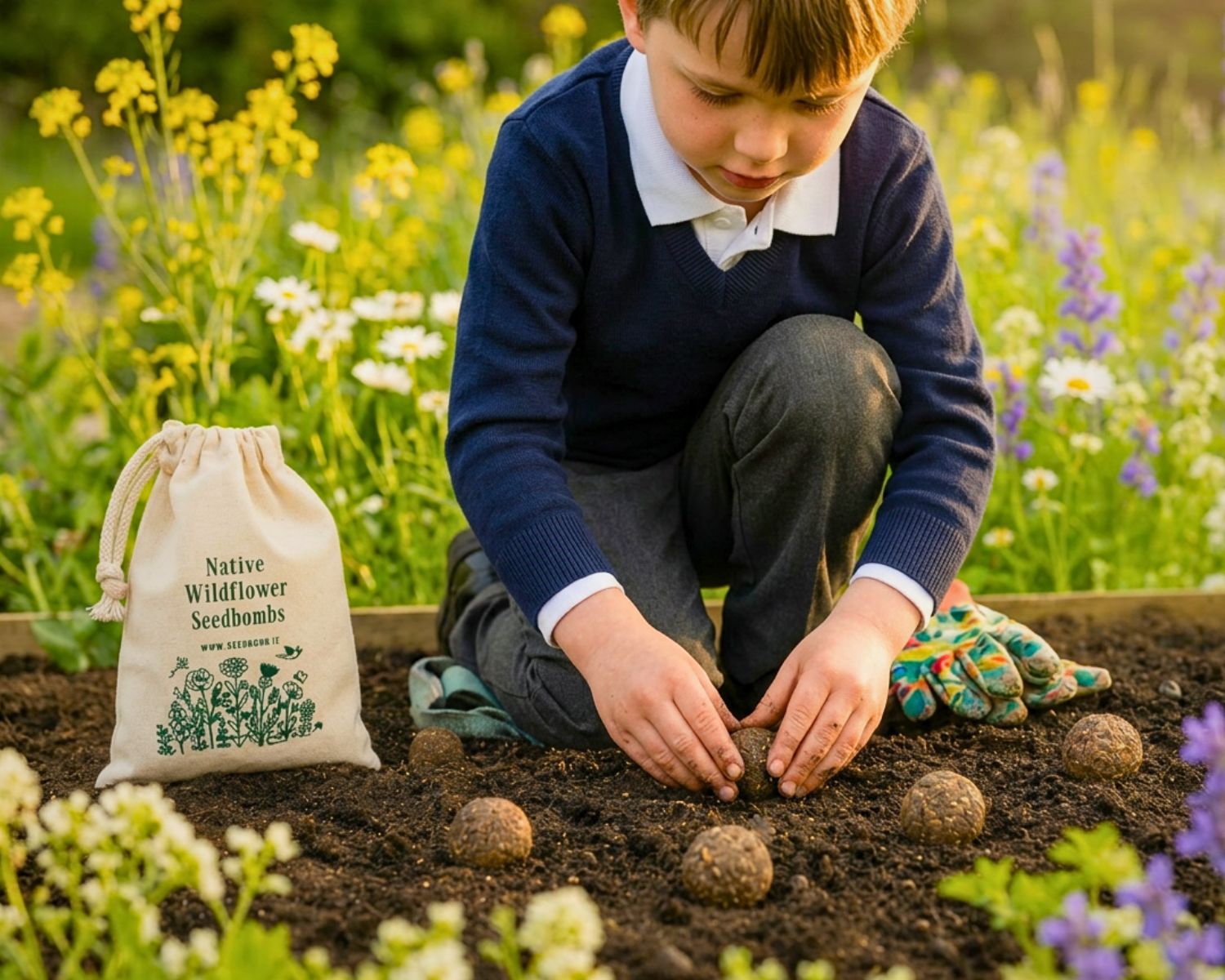
The best locations are visible, safe and easy to care for. Pupils and volunteers should be able to water the area during dry spells and observe the project without disturbing the planting.
Better project locations
- School garden beds with prepared soil.
- Raised beds in outdoor learning areas.
- Large pots, tubs and planters.
- Courtyard planters with good light.
- Community beds where planting is permitted.
- Small visible patches that can be watered and observed.
Locations to avoid
- Long grass or dense lawn.
- Hard compacted ground without preparation.
- Concrete, paving or gravel without soil.
- Areas likely to be sprayed or strimmed.
- Private or public land without permission.
- Places pupils cannot safely access or observe.
What children can learn from seed bomb school projects
Seed bomb school projects can support simple, hands-on learning across nature, science, sustainability and observation.
Simple project roles for pupils
Giving pupils clear roles helps make the project easier to manage and turns the planting into a shared class activity.
Soil team
Helps clear loose debris, check the planting area and prepare the surface before the seed bombs are placed.
Planting team
Places seed bombs by hand, gently presses them onto the surface and records where they were planted.
Watering team
Checks moisture during dry weather and waters gently when the teacher or organiser decides it is needed.
Observation team
Records germination, plant growth, flowers and any insects that visit the project area.
The 29 species SeedBomb.ie wildflower mix
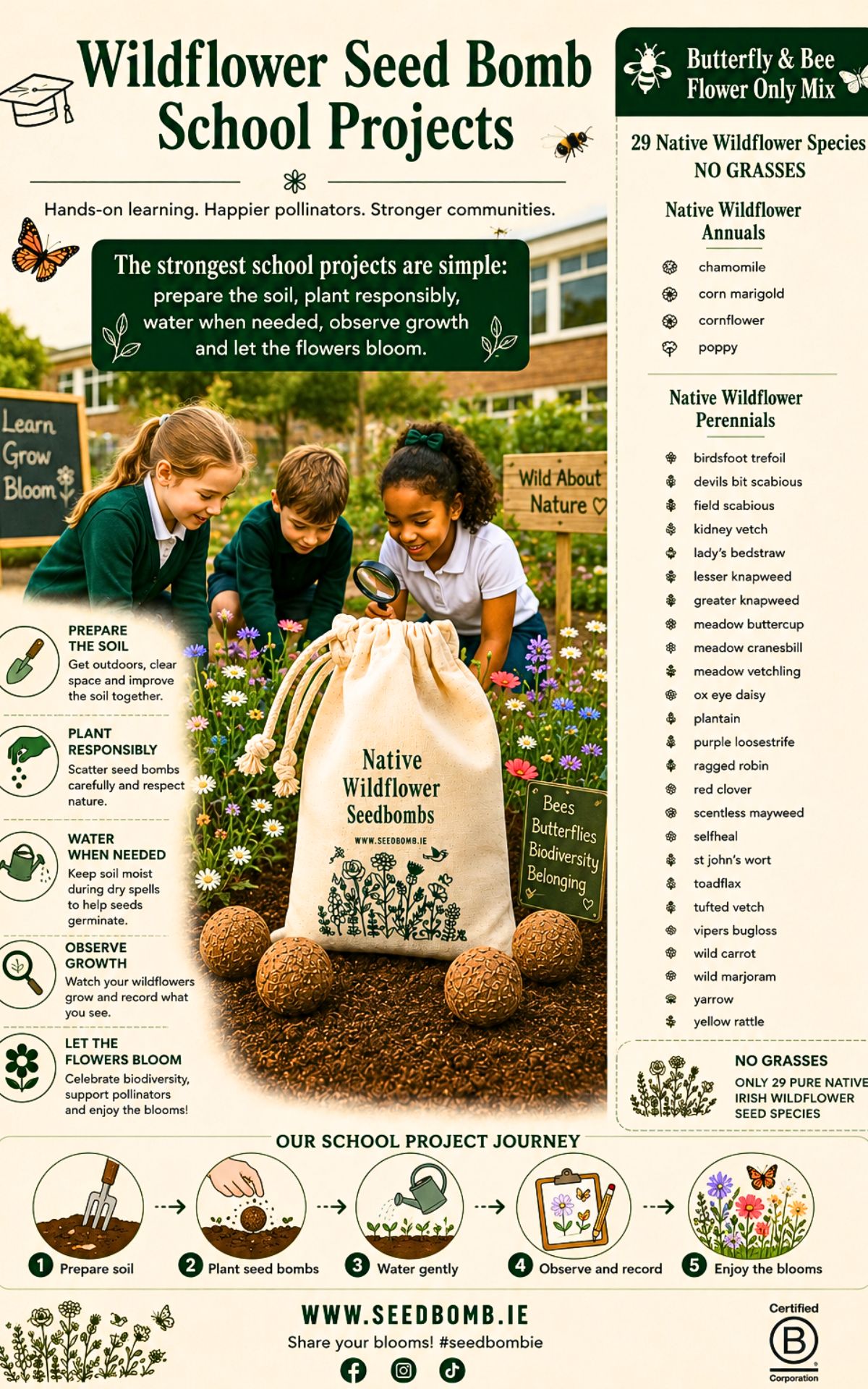
The SeedBomb.ie Bee and Butterfly wildflower mix contains 29 wildflower species and no grasses.
- Chamomile
- Corn Marigold
- Cornflower
- Poppy
- Birdsfoot Trefoil
- Devil's Bit Scabious
- Field Scabious
- Kidney Vetch
- Lady's Bedstraw
- Lesser Knapweed
- Greater Knapweed
- Meadow Buttercup
- Meadow Cranesbill
- Meadow Vetchling
- Ox Eye Daisy
- Plantain
- Purple Loosestrife
- Ragged Robin
- Red Clover
- Scentless Mayweed
- Selfheal
- St John's Wort
- Toadflax
- Tufted Vetch
- Vipers Bugloss
- Wild Carrot
- Wild Marjoram
- Yarrow
- Yellow Rattle
Common school project mistakes
The most common problems happen when seed bombs are treated as a throwaway activity rather than a living project that needs soil, water, light and follow-up.
- Throwing seed bombs into long grass.
- Planting where pupils cannot safely observe the area.
- Using hard ground without preparing the soil.
- Forgetting to water pots or planters during dry weather.
- Letting the area be sprayed, strimmed or mown too early.
- Planting on land where the school or organiser does not have permission.
- Expecting instant wildflower results without seasonal growing time.
Native Wildflower Seed Bombs for School Projects
A simple planting format for school gardens, pots, planters, community projects, biodiversity learning and outdoor education.
Use them for class projects, school events, family nature activities, community planting, wedding favours and sustainable branded gifts.
Frequently asked questions
Are seed bombs suitable for school projects?
Yes. They work well for supervised school projects when planted into pots, planters, raised beds or prepared soil where pupils can water and observe them.
Can children plant seed bombs themselves?
Yes, with adult guidance. Pupils can place seed bombs onto prepared soil, press gently, water and record what happens over time.
Can seed bombs be used in a school lawn?
Dense lawn is not ideal. Clear a small bare patch first so the seed bomb can make contact with soil and seedlings can get light.
What age group can use seed bombs?
Seed bombs can be used across many age groups when the activity is supervised and adapted to the children’s level of understanding.
How long does a school seed bomb project take?
Timing depends on season, soil, moisture, light and species. The strongest learning comes from observing the full process over time rather than expecting instant results.
Further reading
For wider biodiversity ideas that can support school and community discussions, the National Biodiversity Data Centre provides simple guidance on practical ways to help biodiversity.
Ready to start seed bomb school projects?
Choose handcrafted Irish wildflower seed bombs for schools, gardens, pots, community projects, wedding favours and sustainable branded gifts.